
Most factory owners we talk to say the same thing: “We know something is slipping — we just can’t put a finger on exactly where.”
Inventory that doesn’t match the books. Finished goods that vanish between the production line and the loading dock. A customer calling to ask where their order is — and nobody on your team has a straight answer.
These aren’t rare problems. They’re happening every single day in manufacturing plants across India. And the frustrating part is that most of them are completely preventable.
The companies that have figured this out aren’t necessarily bigger or better funded than yours. They just made one decision earlier — they implemented a proper RFID tracking system across their operations.
Here’s what that decision actually changes.
The Hidden Cost of Not Knowing
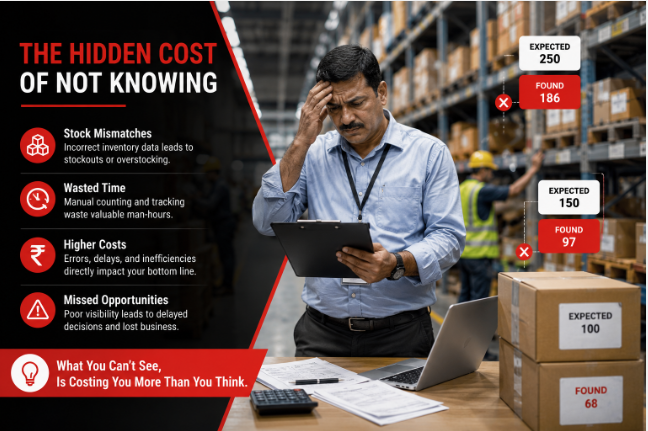
There’s a cost that never shows up on your P&L statement, but it’s real and it adds up fast.
Every time a worker walks the floor doing a manual stock count — that’s time and salary being spent on something a system should be doing automatically. Every time a shipment goes out with the wrong quantity — that’s a credit note, a customer complaint, and a dent in your reputation. Every time production slows down because nobody can find a critical component — that’s machine idle time and delayed delivery.
A well-implemented RFID solution doesn’t just track things. It closes the gap between what you think is happening in your facility and what’s actually happening.
Why Indian Manufacturing Plants Specifically Need This Now
The pressure on Indian manufacturers right now is unlike anything in the last two decades.
Export-oriented units are being asked to meet increasingly strict traceability requirements. Large OEMs and automotive companies are demanding component-level tracking from their tier-2 and tier-3 suppliers. GST compliance and inventory accuracy are under tighter scrutiny. And with rising labour costs, the old model of solving operational problems by adding more people is simply not viable anymore.
RFID solutions are no longer a luxury that only large corporations can afford. The cost of passive RFID tags has come down dramatically. A reliable, scalable RFID tracking system can be deployed in a mid-size Indian manufacturing plant today for a fraction of what it cost five years ago.
The companies waiting for the “right time” are discovering that the right time already passed.
Which industries are already using RFID?
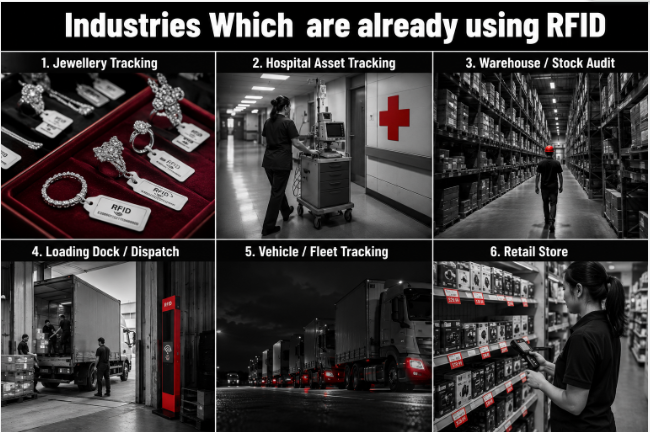
RFID is not just for big factories. It is being used across a wide range of businesses — from hospitals to retail stores to jewellery shops.
Jewellery
| Hospitals | Textiles | Warehouses
|
Track every piece by weight, design, and location. Reduce theft and audit losses instantly.
| Track medicines, equipment, and high-value devices in real time across departments.
| Track rolls, garments, and shipments — from production to dispatch — with zero confusion.
| Know exactly where every pallet, bin, and batch is — without walking the floor.
|
Automotive
| Retail
| Logistics
| Pharma
|
Component-level traceability for tier-2 and tier-3 suppliers — now a standard OEM requirement.
| Reduce shrinkage, speed up billing, and keep shelves accurately stocked at all times.
| Real-time vehicle and cargo tracking. Know where your shipment is at every moment.
| Batch tracking, expiry management, and regulatory traceability built in from day one.
|
Real problems RFID solves — use cases worth knowing
These are not hypothetical situations. These are the exact problems RFID systems fix every day in plants across India.
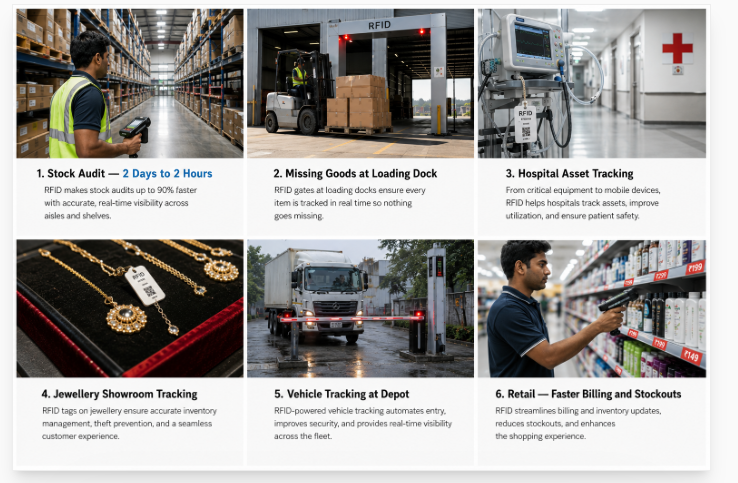
- Stock audits that used to take 2 days — now done in 2 hours
In a traditional warehouse, counting stock means walking every aisle, scanning barcodes one by one, and matching against a spreadsheet. With RFID readers at entry/exit points, your stock count updates itself. No stoppage. No extra manpower needed. - Missing goods between the production line and the loading dock
This is one of the most common and costly problems in manufacturing. An RFID gate at the dock door catches every item that moves in or out — automatically. If something leaves without a dispatch order, you know instantly.
- High-value asset tracking in hospitals and labs
Infusion pumps, surgical kits, ventilators — they move between departments constantly. RFID tags tell staff exactly where each item is, reducing the time wasted searching and making sure critical equipment is always where it should be.
- Jewellery showroom — know where every piece is, always
Each piece gets a unique RFID tag. At the end of the day, a handheld reader checks every item in 10 minutes instead of 2 hours. Missing pieces trigger an instant alert. Theft losses drop dramatically. Customer trust goes up.
- Vehicle tracking in logistics fleets
RFID at depot entry and exit points logs every vehicle automatically — time in, time out, cargo on board. No manual logbooks. No disputes at the gate. Clean, accurate records for every trip.
- Retail — fewer stockouts, faster billing
Retailers using RFID know their exact shelf count without sending staff to manually check every product. Fast-moving items that are running low trigger automatic replenishment alerts. At the billing counter, multiple items are scanned in seconds — no barcode hunting required.
Traditional method vs. RFID — a plain comparison
| How your business runs today vs. how it runs with RFID | |
| Traditional method | With RFID |
| Stock count done manually — staff walk every aisle, scan barcodes one by one. Takes 1–2 full days. | RFID readers at gates update stock automatically. Full audit done in under 2 hours — zero manual effort. |
| You find out goods are missing only after a customer complaints or a shortage hits production. | Every movement is logged in real time. Alerts fire the moment something moves without a valid reason. |
| Location of a batch or component is “check with the stores team” — multiple calls, delays, frustration. | Any team member can look up any item’s location on a screen in under 10 seconds. |
| Dispatch errors happen — wrong quantity, wrong product — discovered only when the customer calls. | RFID gate at loading dock validates every outgoing shipment against the order — before the truck leaves. |
| Production stops because a critical component can’t be found. Machines sit idle. | Supervisor sees a shortage forming on a screen and acts before it becomes a stoppage. |
| Compliance reports take days to compile — pulling records from multiple registers, spreadsheets, people. | Full traceability report — batch origin, movement history, dispatch record — exported in minutes. |
What Changes the Day You Go Live
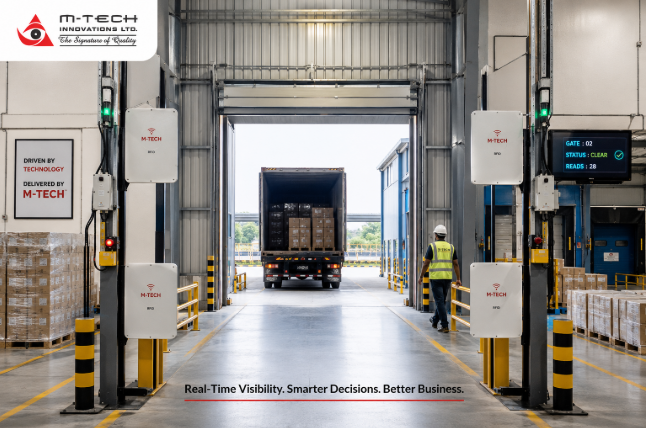
The first thing people notice after implementing an RFID tracking system isn’t some dramatic transformation. It’s something much quieter — and more valuable.
They stop firefighting.
When every pallet, every bin, every finished good carries an RFID tag that communicates its location and status in real time, your team stops spending their day chasing information. The information comes to them.
A dispatch manager knows exactly what’s ready to load before he walks to the dock. A production supervisor sees a bottleneck forming on Line 3 before it becomes a stoppage. A warehouse team completes a full stock audit in two hours instead of two days.
That shift — from reacting to problems to seeing them before they happen — is what manufacturers who’ve made this investment talk about most. Not the technology. The calm.
Why Indian manufacturers need this now
The pressure on Indian manufacturers right now is unlike anything in the last two decades. Export-oriented units are being asked to meet stricter traceability requirements. Large OEMs and automotive companies are demanding component-level tracking from tier-2 and tier-3 suppliers. GST compliance and inventory accuracy are under tighter scrutiny. And with rising labour costs, adding more people to solve operational problems is simply not viable anymore.
RFID is no longer a luxury that only large corporations can afford. The cost of passive RFID tags has come down dramatically. A reliable, scalable system can be deployed in a mid-size Indian manufacturing plant today for a fraction of what it cost five years ago.
The companies waiting for the “right time” are discovering that the right time already passed.
One Question Worth Asking Yourself
If someone asked you right now — “Where is your highest-value raw material batch right now, and when did it arrive?” — how long would it take your team to answer accurately?
If the answer is “a few minutes” or “I’d have to check with the stores team,” that’s the gap. That’s what an RFID tracking system closes.
The data exists in your facility. Products move, materials shift, goods are dispatched — all of that is happening. The only question is whether that information is being captured automatically and made available to the people who need it, or whether it’s disappearing into the noise of daily operations.
Ready to Understand What’s Right for Your Plant?
Every manufacturing facility is different. There’s no one-size-fits-all RFID solution — but there is a right answer for your specific operation, and finding it starts with a conversation.
M-Tech India has worked with manufacturing companies across industries — automotive, pharma, FMCG, electronics, textiles — to design and implement RFID tracking systems that solve real problems and deliver real returns.
Talk to our team at m-techindia.com — and let’s figure out what’s possible for your facility.