
You’ve seen barcodes your entire life — on cereal boxes, shipping labels, at the grocery checkout. They work. They’re simple. But here’s the thing: the world of business has gotten a lot faster and a lot bigger. And barcodes, as useful as they are, have limits that can quietly cost you thousands every year.
That’s where RFID (Radio Frequency Identification) comes in. It’s not a buzzword. It’s the same technology inside your pet’s microchip, your office access card, and the inventory systems of companies like Walmart, Amazon, and McDonald’s. And it’s changing how businesses track, manage, and protect their assets.
Let’s break it all down — in plain language, no jargon.
What Exactly Is RFID? (And How Does It Work?)
Imagine you could scan 200 items in a warehouse without touching a single one — without even looking at them directly. That’s RFID in action.
RFID stands for Radio Frequency Identification. It uses radio waves to read information from a small electronic chip called an RFID tag. Here’s the simple version of how it works:
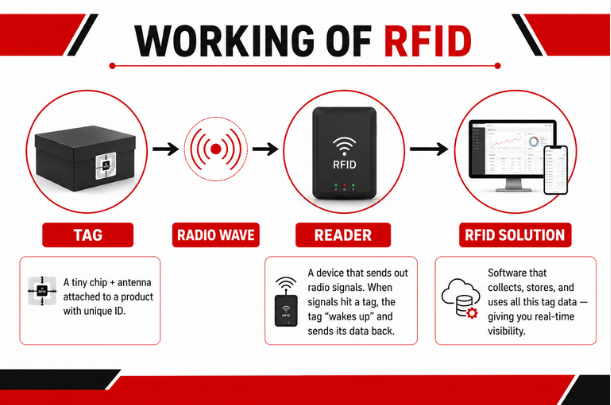
RFID Tag
A tiny chip + antenna attached to a product, pallet, or asset. Stores a unique ID.
RFID Reader
A device that sends out radio signals. When signals hit a tag, the tag “wakes up” and sends its data back.
RFID Solution
Software that collects, stores, and uses all this tag data — giving you real-time visibility.
No batteries needed for passive RFID tags. No line-of-sight required. No one manually scanning one item at a time. The reader does all the work.
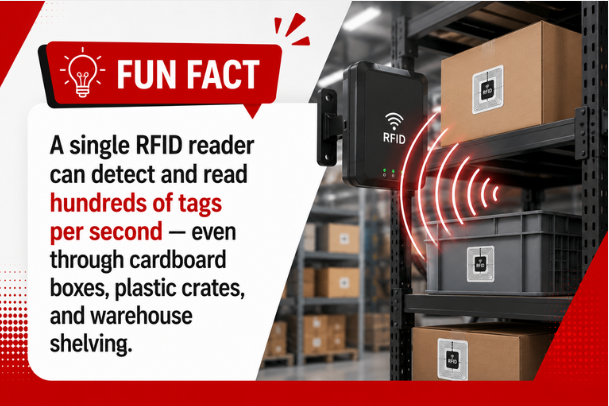
Fun fact
A single RFID reader can detect and read hundreds of tags per second — even through cardboard boxes, plastic crates, and warehouse shelving.
What About Barcodes?
Barcodes have been around since the 1970s — and they’ve done a great job for 50+ years. A barcode is a printed pattern of lines (or squares, in the case of QR codes) that stores a small amount of information. A barcode scanner reads that pattern using a beam of light.
Simple. Cheap. Widely used. But here’s the catch: you need a direct, clear line of sight to scan a barcode. One item at a time. One scan at a time. If the label is torn, dirty, or facing the wrong direction — it won’t scan.
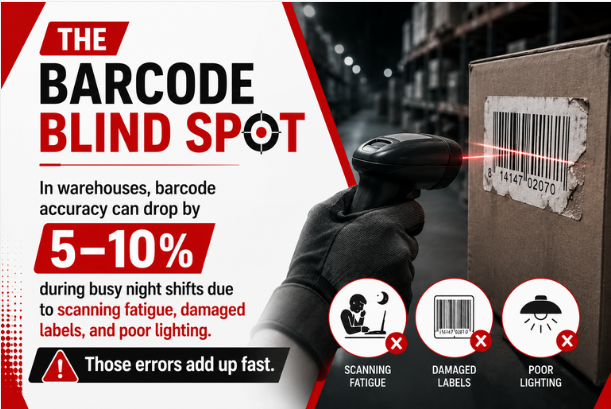
The barcode blind spot
In warehouses, barcode accuracy can drop by 5–10% during busy night shifts due to scanning fatigue, damaged labels, and poor lighting. Those errors add up fast.
RFID vs Barcode: Head-to-Head Comparison
Let’s put these two technologies side by side across the things that matter most to a business:
Factor | RFID | Barcode |
Scanning Method | Radio waves — no line of sight needed | Optical scan — direct line of sight required |
Speed | Hundreds of tags per second | One item at a time |
Inventory Accuracy | 95%–99% accuracy | 65%–80% in high-volume environments |
Data Storage | More data — can be rewritten | Fixed, read-only data |
Durability | Works in dust, heat, moisture | Label can get torn, wet, or dirty |
Cost Per Tag | $0.10–$1+ per tag (dropping fast) | Pennies per label |
Setup Cost | Higher upfront investment | Very low cost to start |
Real-Time Tracking | Yes — automatic, continuous | Only when manually scanned |
Security | Encrypted, harder to clone | Readable by any scanner |
Scalability | Grows easily with your business | Limited by manual scanning speed |
RFID in Numbers: Why Businesses Are Switching
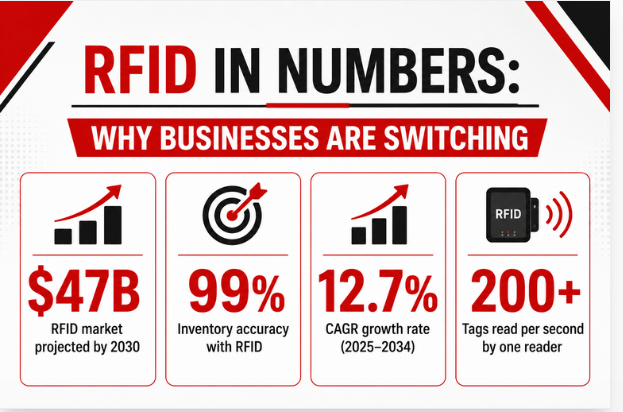
The numbers don’t lie. The global RFID market was valued at $16.8 billion in 2024 and is growing at nearly 13% per year. Retailers, logistics companies, hospitals, and manufacturers are all investing in RFID solutions — because the ROI is real.
Types of RFID Tags: Which One Do You Need?
Not all RFID tags are the same. Before you invest in an RFID solution, it helps to understand the three main types of RFID tags:
- Passive RFID Tags
No battery. No power source. The RFID reader sends out a radio signal that powers the tag just enough to send back its data. These are the most common and most affordable tags — used in retail inventory, supply chains, and access cards. They’re also what’s inside your pet’s microchip.
- Active RFID Tags
These have a built-in battery and can broadcast their signal continuously. They’re used for tracking high-value assets over long distances — like shipping containers, vehicles, or heavy equipment. More expensive, but incredibly powerful for real-time location tracking.
- Semi-Passive RFID Tags
A middle ground — they have a battery to power the chip but rely on the reader’s signal to transmit. Used in environments where consistent, reliable reads are critical (like cold chain logistics, where temperature sensors may be added).
Most businesses start with passive UHF RFID tags
They’re affordable, durable, and can be read from up to 30 feet away. Perfect for retail, warehousing, and general inventory management.
How RFID Readers Work — And Why It Matters
The RFID reader (also called an interrogator) is the engine of your RFID solution. It does two jobs: sends out radio frequency energy to power nearby RFID tags, then listens for the tags to respond with their stored data.
Readers come in different forms depending on your use case:
- Fixed Readers
Mounted at dock doors, conveyor belts, or shelving units. Reads every tag that passes automatically — zero human input
- Handheld Readers
Staff carry these like smartphones. Great for cycle counts, item searches, and receiving. Some connect directly to a mobile phone.
- Portal Readers
Set up as a “gate” — when a pallet or cart moves through, every item is logged instantly. Common in warehouses and retail back rooms.
What Makes a Complete RFID Solution?
Buying RFID tags and a reader is just the start. A real RFID solution brings together hardware, software, and processes to give your business a complete picture of your inventory or assets in real time.
A full RFID solution typically includes:
- RFID Tags — attached to every item, pallet, or asset you want to track
- RFID Readers — fixed portals, handhelds, or both, depending on your operation
- Middleware — software that filters and processes raw tag data before it goes into your systems
- Integration with ERP/WMS — connecting RFID data to your existing inventory or warehouse management system
- Analytics Dashboard — so you can actually see, use, and act on all this data
Where RFID Wins: Real Industries, Real Results
RFID isn’t just theory. These are the industries where it’s delivering the biggest results right now:
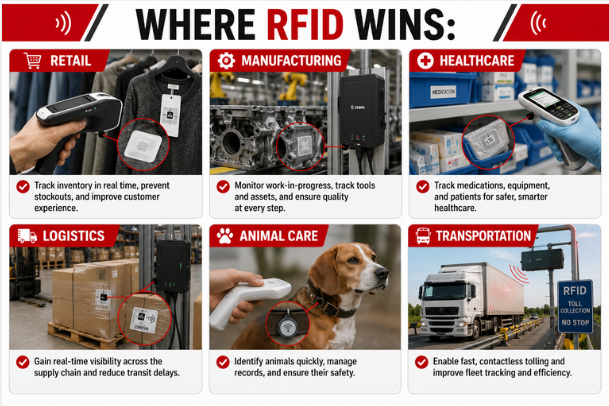
Retail Walmart, Zara, and H&M use RFID for item-level tracking. Fewer stockouts, faster checkout, better shrink control.
Manufacturing : Track components on production lines in real time. Predictive maintenance, quality control, and zero misplaced parts.
Healthcare: Hospitals use RFID for patient tracking, medication management, and preventing equipment loss.
Logistics: Bands now uses RFID to track food packages from factory to restaurant — a perfect example of supply chain transparency.
Animal Care : RFID pet microchips are now mandatory for dogs & cats for traveling , Insurance & Health Tracking.
Transportation : Automated toll collection by using RFID tags on vehicles — no stopping required.
Pros & Cons: RFID and Barcode
RFID Technology
Pros of RFID | Cons of RFID |
|
|
Barcode Technolog
Pros of Barcodes | Cons of Barcodes |
|
|
Which One Is Right for YOUR Business?
Here’s an honest decision guide. No upsell, no fluff — just the right tool for the right job:
Your Situation | Best Choice | Why |
Small shop, simple inventory, tight budget | Barcode | Low cost, easy to use, plenty accurate at small scale |
Large warehouse, high-volume goods | RFID | Speed and bulk-scanning are essential at this scale |
Retail with frequent stock counts | RFID | Cycle counts go from hours to minutes |
Tracking expensive or critical assets | RFID | Real-time location, encrypted data, harder to fake |
Simple product labelling for customer use | Barcode | Consumers can scan with phones — barcodes are universally readable |
Pro tip from practitioners
Many businesses use both. Start with RFID at your receiving dock and dispatch area. Keep barcodes for customer-facing products. Scale RFID across the floor as ROI becomes clear.
Common Questions About RFID
Is RFID worth the investment for a small business?
It depends on your growth plans. If you’re managing fewer than 500 SKUs and doing manual counts weekly, barcodes are fine. But if you’re growing fast, struggling with shrinkage, or losing time on stock counts — RFID pays for itself quickly. Many vendors now offer affordable starter RFID solutions built for small businesses.
Can RFID tags be read through walls or packaging?
Yes — RFID tags can be read through cardboard, plastic, and most non-metallic materials. Metal and liquids can reduce the read range, but modern RFID tag designs have largely overcome this through smart antenna design and tag placement guidance.
How does an RFID reader work exactly?
An RFID reader emits radio frequency energy in a specific range. When a passive RFID tag enters that field, the antenna in the tag harvests that energy, powers the chip, and broadcasts its unique ID back to the reader. The whole process happens in milliseconds — and it can happen for hundreds of tags at once.
What is an RFID pet microchip and is it safe?
An RFID pet microchip is a passive RFID tag — roughly the size of a grain of rice — sealed in a biocompatible glass capsule and implanted under your pet’s skin. It has no battery, produces no heat, and never needs replacement. It’s completely inert and safe. Millions of pets worldwide carry them, and they’re now legally required Across Globe.
Does RFID replace barcodes completely?
Not necessarily — and probably not overnight. Barcodes are still the most widely used tracking technology on the planet. RFID is best thought of as a powerful upgrade for the parts of your operation where speed, accuracy, and real-time visibility matter most. Many businesses run both side by side.
The Bottom Line
Barcodes are a bit like a reliable old car — gets you where you need to go, not much to complain about, but there’s a newer model in the showroom that does a lot more.
RFID is that newer model. It’s faster, smarter, and more powerful. For businesses dealing with large volumes, complex supply chains, or valuable assets — an RFID solution isn’t a luxury, it’s becoming a necessity.
Whether you’re starting with a simple set of RFID tags on your most valuable stock, setting up a full-warehouse RFID reader network, or simply getting your pet a microchip — you’re working with the same underlying technology that’s reshaping how the world tracks and manages everything that matters.