




Smart Card Technology
An LED card looks like an ordinary contactless card until it approaches a compatible reader. The embedded LED lights up while the card is within the reader's electromagnetic field and switches off when the card moves away. There is no battery inside the card. The light is powered by energy harvested from the reader itself.
Understanding how this technology works helps product managers, procurement engineers and system integrators evaluate LED cards for access control, banking, automotive, hospitality and other identification applications. This guide explains the operating principle, key engineering considerations, common failure modes and the factors to evaluate before specifying an LED card.
1. What Is an LED Card?
An LED card is a contactless smart card or RFID card that incorporates a light-emitting diode alongside its chip and antenna. The LED provides a visual indication that the card is within the reader's electromagnetic field.
The card continues to perform its normal function, such as authentication, payment data exchange or identification. The illuminated element adds a visual feature without requiring an internal battery.
M-Tech Innovations Ltd., a smart card manufacturer based in Pune, offers smart card solutions for different applications, including access control, NFC business cards, metro access and banking variants. The exact chip, interface and construction depend on the intended application.
2. How Does an LED Card Work Without a Battery?
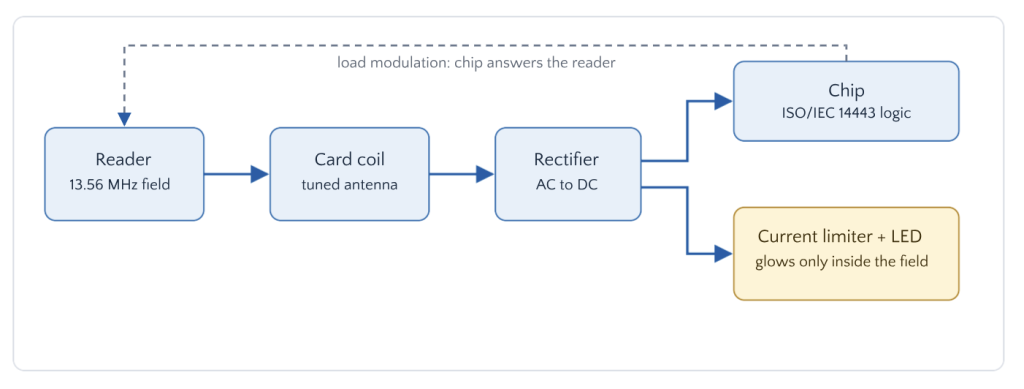
High-frequency (HF) contactless cards commonly operate at 13.56 MHz. The reader's antenna generates an alternating magnetic field. When the card's coil antenna enters this field, a voltage is induced in the coil through a process known as inductive coupling.
The harvested energy can power the card's chip and, in a suitably designed LED card, its light-emitting circuit. The LED therefore does not need a conventional battery.
The Five-Step Operating Process
- The reader generates a magnetic field. The reader energises its antenna and produces the 13.56 MHz field used for contactless communication.
- The card antenna couples to the field. The card's tuned coil antenna receives energy from the field. Its inductance and capacitance help establish resonance near the operating frequency.
- The induced voltage is rectified. A rectification circuit converts the induced alternating voltage into direct current for the chip and the LED circuit, as applicable to the design.
- The chip communicates with the reader. The chip powers up and exchanges data. In systems using load modulation, the card changes the load on its antenna so the reader can detect the response.
- The LED illuminates. A portion of the harvested energy powers the LED through an appropriate current-limiting arrangement. The LED lights while sufficient energy is available.
Key takeaway: The LED does not generate its own energy. It uses a portion of the energy collected from the reader's field. Illumination therefore depends on the reader, antenna design, circuit loading and distance from the reader.
3. Key Design Parameters of RFID LED Cards
Designing a reliable LED card involves balancing illumination, communication performance, physical construction and visual appearance. Five factors deserve particular attention.
3.1 Antenna Geometry and Tuning
The number of antenna turns, track width and coil area influence inductance. Together with the chip's input capacitance and any additional tuning capacitance, these parameters determine the resonant frequency.
If the antenna is poorly tuned, the card may harvest less energy and operate at a shorter read distance. Adding an LED branch changes the electrical loading, so the antenna should be evaluated and tuned in the completed card assembly rather than only in the original inlay.
3.2 LED Selection and Current
Since harvested power is limited, a low-power, high-efficiency LED is generally preferable. Forward voltage also matters. Red LEDs typically have a lower forward voltage than blue or white LEDs, which can affect how easily the LED illuminates near the edge of the reader's operating zone.
The LED and its current-limiting circuit must be selected to suit the available energy and intended illumination level.
3.3 Read Range Versus Brightness
Energy consumed by the LED is not available to the chip. A brighter LED generally draws more current and may reduce read distance or make communication less reliable with weaker readers.
The design objective is to achieve clearly visible illumination while maintaining reliable chip operation on the intended readers, including compatible phones where mobile NFC support is required.
3.4 Card Thickness and Construction
The LED and its associated circuitry add physical height. Standard ID-1 cards are nominally 0.76 mm thick, while cards incorporating embedded components may be thicker depending on their construction.
Verify the finished card's thickness against the intended card printer, reader slot and card holder. Lamination, cavity milling and the choice of PVC or another substrate can also affect durability and flexibility.
3.5 Light Guiding and Graphics
Printed masks and light-diffusing layers can help shape the glow into a logo, ring or other symbol. The artwork should be developed alongside the LED position because the LED is a point light source, and the layers above it determine how evenly the light spreads.
4. Applications of LED Cards
LED cards combine contactless functionality with a visual element that can improve user feedback or support a distinctive product design.
- Access Control Illumination provides a visible indication that the card has entered the reader's field. This can be useful at turnstiles, entrances and dimly lit corridors.
- Banking and Payments An illuminated feature can provide a distinctive branded experience on premium debit or credit cards. Payment cards must still meet applicable payment scheme, certification and security requirements.
- Automotive LED-enabled key cards can incorporate an illuminated brand mark or other visual design element.
- Hospitality and Memberships Hotel key cards, club memberships and gym cards can use illumination to enhance the physical card design and customer experience.
- Transit and Event Passes Metro access cards and event passes can use a visual cue to help communicate that the card is within a reader's field.
5. How to Specify an LED Card: Procurement Checklist
Before finalising an LED card specification, procurement teams and system integrators should confirm the following requirements with the manufacturer.
- Chip family and frequency: Specify the required chip and interface, such as HF Type A, Type B or dual-interface, as applicable.
- Read range: Define the required performance on the actual readers and compatible phones used in the application.
- LED configuration: Confirm LED colour, number of LEDs and the desired illumination pattern.
- Card thickness: Verify compatibility with existing card printers, reader slots and card holders.
- Artwork and personalisation: Provide branding artwork, personalisation requirements and data to be encoded.
- Environmental requirements: Specify flexibility, operating temperature, humidity exposure and expected service life.
- Volumes and quality acceptance: Agree on production quantities, sampling plans and acceptance tests before bulk production.
Recommendation: Request production-representative samples and test them on the intended readers before approving a bulk order. Evaluate both LED visibility and contactless communication performance.
6. Common LED Card Failure Modes
LED cards require careful electrical and mechanical design. Understanding common failure modes helps teams identify potential issues during development, sampling and quality inspection.
- Weak or flickering illumination: May result from an antenna tuning mismatch or insufficient LED current for the available reader field.
- Reduced read range: Can occur when the LED circuit places excessive electrical loading on the antenna.
- Cracked solder joints or bond points: May result from inadequate flexibility or poor mechanical design around the LED. Components should be kept away from high-stress areas.
- Inconsistent brightness between batches: May be associated with variations in lamination thickness or LED binning. Batch-level inspection helps identify inconsistent output.
7. Why Work with an Indian Smart Card Manufacturer?
Working with a manufacturer in India can simplify communication, sample reviews, artwork changes and production coordination for programmes serving the Indian market.
According to its published company information, M-Tech Innovations Ltd. states that it was the first Indian-owned company to receive Visa certification for security card manufacturing, and reports Mastercard, RuPay, EMV and ISO-related credentials. Buyers should confirm the exact certifications, scope and current validity relevant to their project.
When evaluating a supplier, review the required certifications, technical specifications, sample performance, quality-control process and ability to support the intended production volumes.
Visit M-Tech Innovations Ltd. to learn more about the company's smart card solutions.
8. Frequently Asked Questions About LED Cards
Do LED cards need a battery?
No. In a passive RFID or NFC LED card designed for this purpose, the LED uses energy harvested from the reader's electromagnetic field. It generally illuminates only while sufficient energy is available near the reader.
Does the LED affect the card's security?
The LED itself does not provide security or replace the chip's cryptographic functions. Security depends on the chip, card implementation, authentication protocol and issuing system.
Can an LED card work with a mobile phone?
Some LED cards can work with compatible NFC-enabled phones. However, phone-generated fields and operating conditions can differ from fixed readers, so test the specific card and phone combinations before confirming compatibility.
Can the LED illuminate a custom logo?
Yes. A custom illuminated effect can be designed using suitable LED placement, light-guiding layers and printed masks. The final appearance depends on the card's optical and physical construction.
Are LED cards suitable for access control?
They can be suitable for access control when the card's chip, frequency, protocol and antenna design are compatible with the installed reader system. The LED adds a visual indication of field exposure; it does not independently confirm that access has been authorised.
Looking for LED Card Solutions?
If you are evaluating RFID or NFC LED cards for access control, banking, transit, automotive or membership applications, define your technical requirements and validate the finished card on your intended readers.