
M-Tech Innovations Ltd

How RFID E-Seals Rewired Indian Export Logistics

A one-time-use bolt, a passive UHF chip and a cloud record now decide whether an Indian export container is waved through or opened. Here is how that works, where it has gone wrong, and what to audit before you buy.

Before 2017, an Indian exporter who wanted a container sealed for the port often had to wait for a customs officer to turn up at the factory. Stuffing was supervised, the seal was mechanical, and anything that happened between the factory gate and the quay was settled by paper and trust.

Then the rules changed. In August 2017 the Central Board of Excise and Customs allowed eligible exporters to self-seal. In October 2017 it paired that with an RFID e-seal, a bolt whose chip tells a reader, from a few metres away, whether the container has been opened. 1,2

1.6 million

₹200–300

+60%

e-seals used by 12,500+ exporters by 31 March 2019 3

typical vendor price per seal with software access, reported in 2018 4

rise in estimated US and Canada cargo-theft losses in 2025, to nearly $725M 5


This is not a general explainer on what RFID is. It is a close look at one RFID product category, the container e-seal, in one business vertical, export logistics. It covers the mechanism, the standards behind it, a trust failure that ended up in the Karnataka High Court, and the 2026 developments that make the category worth watching.

What changed in 2017, and what changed again in 2026

Indian Customs had a practical problem. Mechanical seals had no proper standard, gave no reliable alert on a breach and offered no visibility on movement, which pushed up controls, costs and transaction times. Replacing them with electronic seals let the administration cut fraud risk while giving trusted traders more facilitation. 3

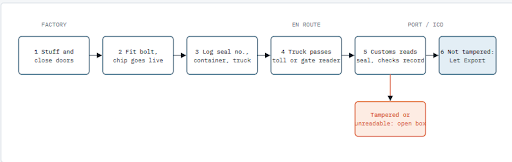
The scheme is open to authorised economic operators and exporters on the self-sealing procedure. The exporter fills in the seal number, container number, vehicle registration and export declaration number on a vendor’s web application. At the port or a toll plaza, customs reads the seal with a fixed or handheld reader and checks that record. 3

When

What happened

28 Aug 2017

Self-sealing by exporters starts, with electronic sealing under Circular 36/2017 6

30 Oct 2017

Circular 41/2017: a full container arriving at a port or ICD with an RFID e-seal read as intact is treated as equivalent to one sealed under officer supervision 7

Oct–Nov 2018

Customs houses at Nhava Sheva, Mumbai and Chennai issue trade notices on e-seal security concerns 8

2026 (Circular 14/2026)

Self-sealing permission no longer expires, but can be withdrawn for misuse such as tampering with seals 9

15 Apr 2026 (Circular 21/2026)

Procedure for export containers off-loaded at foreign ports and returned because of the Strait of Hormuz disruption. Seals are verified against shipping bills, and a tampered or non-intact seal triggers 100% examination 10

22 Jul 2026 (Instruction 124)

SEZ export containers with valid Let Export Orders to use only RFID seals under Circular 41/2017 11

The 2026 items come from tax-advisory write-ups of the circulars. Check the original CBIC and Department of Commerce text before relying on them for compliance.

Read the 2026 items together. Permission to self-seal is now open-ended, which makes the seal a long-term asset rather than a yearly renewal. The Hormuz circular shows the seal doing a second job: it is the evidence that lets a box that went to sea and came back skip a full inspection.

How one e-seal clears one container

The unusual design choice is where the data lives. Indian Customs chose not to require data to be written into the seal, so exporters would not need to buy write and read devices. The record sits in a cloud application instead, and only Customs, the exporter and the e-seal vendor can see it. 3 The seal itself is an identi

Export container flow under India’s RFID e-seal procedure. Steps drawn from the WCO Magazine account of the scheme and exporter guidance 312. Original diagram.

What is inside the bolt

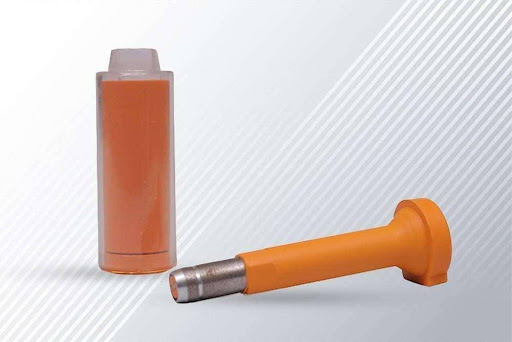
Indian vendors describe a passive UHF seal in the 865–867 MHz band, a carbon-steel bolt, and a chip from a global silicon maker, built to ISO 17712:2013 for one-time use. 13 The tamper logic is simple. The seal should not respond before it is locked, should respond when closed, and should stop responding once cut or damaged. 14 A cut bolt that goes silent is as useful to a reader as one that says “tampered”.

Why passive UHF, when the standard talks about active

Two standards sit behind every seal. ISO 17712 defines the high-security mechanical seal. ISO 18185 defines the electronic seal as a read-only, non-reusable seal that conforms to ISO 17712 and electronically evidences tampering through the container doors. 15 When the standard was published, active RFID was the dominant approach it addressed. 16

India went a different way. Its seals are passive UHF on the ISO 18000-6C protocol, read by handheld or fixed readers at customs stations. 4 That trades the onboard clock, battery and event log of an active seal for a unit price in the low hundreds of rupees and readers that can be shared with other RFID infrastructure. For a country moving millions of consignments a year, the cheap option was the one that could scale.

Where it went wrong: the trust problem

A seal is only as good as the claims behind it. Three episodes show why buyers should ask hard questions.

2018: readable without locking. Customs verification found that some approved vendors’ seals could be read for their export data without being locked. The concern was raised in trade notices from three customs houses, and officers were told they could decide on examination based on perceived risk. 8

2022: switched-off alerts. In October 2022 the Karnataka High Court refused to quash a criminal case against an empanelled e-seal vendor and its director. As reported, the Directorate of Revenue Intelligence found about 832 faulty seals, and the director’s statement to investigators said tamper notifications had been switched off in the back-end software. These are allegations in an ongoing matter, though the court called the circumstances serious for national security. 17

Supply: In the early months, seals were largely imported and lead time was 30 to 45 days, with exporters complaining of vendor service gaps. 4

The lesson: an e-seal has three parts that can fail: the bolt, the chip’s lock-state behaviour and the vendor’s back end. Most buyers only inspect the bolt.

A buyer’s audit checklist

  1. ISO 17712:2013 test evidence. Ask for the lab report and the manufacturer’s security-management certification, not just a logo on the data sheet. Vendors typically cite separate certifiers for the physical clauses and for manufacturing security. 14
  2. Dormant until locked. Request a live demonstration that an open seal returns no readable data, and that a cut seal goes silent or reports tampered.
  3. Tamper alerts you cannot lose. Ask who receives alerts, whether the vendor can disable them, and whether changes to alert settings are logged where you and customs can see them.
  4. TID binding. Each seal’s serial number must be tied to its chip’s unique TID and shared with customs. Customs has also been building a single universal application so officers need not handle many vendor portals. 3
  5. Reader fit. Confirm the seal reads on the fixed and handheld readers at your ports of export, in the Indian 865–867 MHz band.
  6. Stock and lead time. Ask for buffer stock, a written delivery SLA and what happens on a reader or platform outage.
  7. Record access and retention. Know where your shipment data sits, who can read it and for how long.

The economics, without invented numbers

A seal costs far less than the delays it avoids. Exporters on e-sealing no longer pay Merchant Overtime fees to get an officer out of hours, can seal at any time, and sealed cargo need not detour to an ICD for document processing. 4 To test the case on your own lanes, use this framework with your own figures:

  • Monthly seal cost = containers per month × price per seal. At the 2018-reported ₹250, 200 containers is ₹50,000 a month. Ask vendors for current pricing.
  • Avoided cost = overtime fees saved + container-days of detention avoided + inspection delays avoided.
  • Risk cost = value at risk per box × probability of tampering or pilferage on your lane, reduced by faster detection.

Where e-seals are heading

1. Three-state seals

Newer passive UHF seals store UNLOCKED, LOCKED or TAMPERED as a status in the chip itself, so a reader gets both identity and condition in one read. 18 Tamper-evident UHF tags are also sold that report a broken seal without a line of sight. 19

2. RFID plus NFC

Market research points to dual-frequency seals, so an inspector can check a seal with an ordinary smartphone as well as a UHF reader. 20

3. Hybrid fleets, not a single seal

India already uses a GPS-based Electronic Cargo Tracking System for transit cargo, which monitors position, speed and seal integrity. 3 A practical pattern is passive seals on most boxes and connected seals only on high-value or high-risk loads, because connected seals cost more. 21

4. A data layer on top

Industry commentary points to IoT seals, blockchain audit trails and AI cargo monitoring as the next steps toward paperless customs. 22 Treat these as direction rather than deployed fact in India today. The nearer-term value is cleaner data: a seal event tied to a shipping bill is something a risk engine can use.

5. Identity from container to item

Wider 2026 RFID trend pieces put item-level visibility and digital product passports at the centre. 23 The e-seal is the container-level end of the same idea: a unique, verifiable ID that travels with the cargo.

A reality check on market numbers

Analyst figures for the RFID market disagree widely, which matters if you are building a business case on them.

Global RFID, 2025 (USD billion)

Unnamed report via MEXC 24


14.58

Global Market Insights 25


18.5

Value Market Research 26


24.19

India RFID, 2024 (USD billion)

IMARC 27


0.56

TechSci Research 28


1.8

Figure 2. Highest global estimate is about 66% above the lowest; highest India estimate is about 3.2 times the lowest. Bars start at zero; scales differ between the two panels.

The gaps come from scope: what counts as RFID (tags only, or readers, software and services) and how each firm models it. Use one source consistently and state which. What is consistent across them is direction: India is forecast to grow at around 11% a year in two of the reports, and transportation and logistics is called out as the fastest-growing segment in one. 27,28

Beyond export containers

The same seal idea is spreading along the customs chain. CBIC Circular 19/2018 extended electronic sealing to goods moving into and out of customs bonded warehouses, including RFID wire cable seals for closed-body vehicles. 29 Any vertical with high-value, regulated or temperature-sensitive loads can use the same logic: pharmaceutical distribution, electronics, auto components and cross-border e-commerce. The cargo-theft data shows why. In the US and Canada, incident counts were flat in 2025 while the average value per theft rose 36% to $273,990, as organised groups targeted richer loads. 5 That is North American data, not Indian, and it is a signal, not a forecast for India.

The M-Tech E-Seal

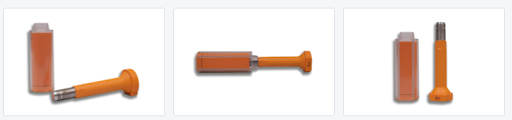
M-Tech Innovations develops and manufactures its RFID Bolt Seal (E-Seal) to the requirements of customs and cargo exporters, under the Make in India initiative. The company says the seal gives real-time tracking and monitoring, carries sensors that detect tamper attempts, and comes with a web application for seal records, tracking and status. It lists test credentials of ISO/IEC 17025:2005 and TÜV SOC 2021-22_0013. 30 Domestic manufacture speaks directly to the lead-time problem exporters raised in the early years.

Talk to M-Tech about e-seals. Use the checklist above as your RFQ. Ask for the test reports, a lock-state demonstration and a lead-time commitment. See the RFID Bolt Seal (E-Seal) page at m-techindia.com/rfid-reader-division/rfid-tags/rfid-bolt-seal/ or contact M-Tech at m-techindia.com/contact/.

Key takeaways

  • India’s e-seal is a compliance tool first: a clean read can replace officer-supervised sealing and speed up port clearance.
  • The data sits in vendor clouds, so vendor integrity matters as much as the bolt.
  • Buy against a checklist: test evidence, lock-state behaviour, alert integrity, reader fit, lead time.
  • The 2026 circulars point to e-seals becoming permanent infrastructure, and the next steps are three-state seals, NFC checks and hybrid GPS for risky loads.

How RFID E-Seals Rewired Indian Export Logistics

A one-time-use bolt, a passive UHF chip and a cloud record now decide whether an Indian export container is waved through or opened. Here is how that works, where it has gone wrong, and what to audit before you buy.

RFID e-seal

Before 2017, an Indian exporter who wanted a container sealed for the port often had to wait for a customs officer to turn up at the factory. Stuffing was supervised, the seal was mechanical, and anything that happened between the factory gate and the quay was settled by paper and trust.

Then the rules changed. In August 2017 the Central Board of Excise and Customs allowed eligible exporters to self-seal. In October 2017 it paired that with an RFID e-seal, a bolt whose chip tells a reader, from a few metres away, whether the container has been opened. 1,2

1.6 million

e-seals used by 12,500+ exporters by 31 March 2019 3

₹200–300

typical vendor price per seal with software access, reported in 2018 4

+60%

rise in estimated US and Canada cargo-theft losses in 2025, to nearly $725M 5

This is not a general explainer on what RFID is. It is a close look at one RFID product category, the container e-seal, in one business vertical, export logistics. It covers the mechanism, the standards behind it, a trust failure that ended up in the Karnataka High Court, and the 2026 developments that make the category worth watching.

What changed in 2017, and what changed again in 2026

Indian Customs had a practical problem. Mechanical seals had no proper standard, gave no reliable alert on a breach and offered no visibility on movement, which pushed up controls, costs and transaction times. Replacing them with electronic seals let the administration cut fraud risk while giving trusted traders more facilitation. 3

The scheme is open to authorised economic operators and exporters on the self-sealing procedure. The exporter fills in the seal number, container number, vehicle registration and export declaration number on a vendor’s web application. At the port or a toll plaza, customs reads the seal with a fixed or handheld reader and checks that record. 3

WhenWhat happened
28 Aug 2017Self-sealing by exporters starts, with electronic sealing under Circular 36/2017 6
30 Oct 2017Circular 41/2017: a full container arriving at a port or ICD with an RFID e-seal read as intact is treated as equivalent to one sealed under officer supervision 7
Oct–Nov 2018Customs houses at Nhava Sheva, Mumbai and Chennai issue trade notices on e-seal security concerns 8
2026 (Circular 14/2026)Self-sealing permission no longer expires, but can be withdrawn for misuse such as tampering with seals 9
15 Apr 2026 (Circular 21/2026)Procedure for export containers off-loaded at foreign ports and returned because of the Strait of Hormuz disruption. Seals are verified against shipping bills, and a tampered or non-intact seal triggers 100% examination 10
22 Jul 2026 (Instruction 124)SEZ export containers with valid Let Export Orders to use only RFID seals under Circular 41/2017 11

The 2026 items come from tax-advisory write-ups of the circulars. Check the original CBIC and Department of Commerce text before relying on them for compliance.

Read the 2026 items together. Permission to self-seal is now open-ended, which makes the seal a long-term asset rather than a yearly renewal. The Hormuz circular shows the seal doing a second job: it is the evidence that lets a box that went to sea and came back skip a full inspection.

How one e-seal clears one container

The unusual design choice is where the data lives. Indian Customs chose not to require data to be written into the seal, so exporters would not need to buy write and read devices. The record sits in a cloud application instead, and only Customs, the exporter and the e-seal vendor can see it. 3 The seal itself is an identi

Export container flow diagram
Export container flow under India’s RFID e-seal procedure. Steps drawn from the WCO Magazine account of the scheme and exporter guidance 3 12. Original diagram.

What is inside the bolt

Indian vendors describe a passive UHF seal in the 865–867 MHz band, a carbon-steel bolt, and a chip from a global silicon maker, built to ISO 17712:2013 for one-time use. 13 The tamper logic is simple. The seal should not respond before it is locked, should respond when closed, and should stop responding once cut or damaged. 14 A cut bolt that goes silent is as useful to a reader as one that says “tampered”.

Why passive UHF, when the standard talks about active

Two standards sit behind every seal. ISO 17712 defines the high-security mechanical seal. ISO 18185 defines the electronic seal as a read-only, non-reusable seal that conforms to ISO 17712 and electronically evidences tampering through the container doors. 15 When the standard was published, active RFID was the dominant approach it addressed. 16

India went a different way. Its seals are passive UHF on the ISO 18000-6C protocol, read by handheld or fixed readers at customs stations. 4 That trades the onboard clock, battery and event log of an active seal for a unit price in the low hundreds of rupees and readers that can be shared with other RFID infrastructure. For a country moving millions of consignments a year, the cheap option was the one that could scale.

Where it went wrong: the trust problem

A seal is only as good as the claims behind it. Three episodes show why buyers should ask hard questions.

2018: readable without locking. Customs verification found that some approved vendors’ seals could be read for their export data without being locked. The concern was raised in trade notices from three customs houses, and officers were told they could decide on examination based on perceived risk. 8

2022: switched-off alerts. In October 2022 the Karnataka High Court refused to quash a criminal case against an empanelled e-seal vendor and its director. As reported, the Directorate of Revenue Intelligence found about 832 faulty seals, and the director’s statement to investigators said tamper notifications had been switched off in the back-end software. These are allegations in an ongoing matter, though the court called the circumstances serious for national security. 17

Supply: In the early months, seals were largely imported and lead time was 30 to 45 days, with exporters complaining of vendor service gaps. 4

The lesson: an e-seal has three parts that can fail: the bolt, the chip’s lock-state behaviour and the vendor’s back end. Most buyers only inspect the bolt.

A buyer’s audit checklist

  1. ISO 17712:2013 test evidence. Ask for the lab report and the manufacturer’s security-management certification, not just a logo on the data sheet. Vendors typically cite separate certifiers for the physical clauses and for manufacturing security. 14
  2. Dormant until locked. Request a live demonstration that an open seal returns no readable data, and that a cut seal goes silent or reports tampered.
  3. Tamper alerts you cannot lose. Ask who receives alerts, whether the vendor can disable them, and whether changes to alert settings are logged where you and customs can see them.
  4. TID binding. Each seal’s serial number must be tied to its chip’s unique TID and shared with customs. Customs has also been building a single universal application so officers need not handle many vendor portals. 3
  5. Reader fit. Confirm the seal reads on the fixed and handheld readers at your ports of export, in the Indian 865–867 MHz band.
  6. Stock and lead time. Ask for buffer stock, a written delivery SLA and what happens on a reader or platform outage.
  7. Record access and retention. Know where your shipment data sits, who can read it and for how long.

The economics, without invented numbers

A seal costs far less than the delays it avoids. Exporters on e-sealing no longer pay Merchant Overtime fees to get an officer out of hours, can seal at any time, and sealed cargo need not detour to an ICD for document processing. 4 To test the case on your own lanes, use this framework with your own figures:

  • Monthly seal cost = containers per month × price per seal. At the 2018-reported ₹250, 200 containers is ₹50,000 a month. Ask vendors for current pricing.
  • Avoided cost = overtime fees saved + container-days of detention avoided + inspection delays avoided.
  • Risk cost = value at risk per box × probability of tampering or pilferage on your lane, reduced by faster detection.

Where e-seals are heading

1. Three-state seals

Newer passive UHF seals store UNLOCKED, LOCKED or TAMPERED as a status in the chip itself, so a reader gets both identity and condition in one read. 18 Tamper-evident UHF tags are also sold that report a broken seal without a line of sight. 19

2. RFID plus NFC

Market research points to dual-frequency seals, so an inspector can check a seal with an ordinary smartphone as well as a UHF reader. 20

3. Hybrid fleets, not a single seal

India already uses a GPS-based Electronic Cargo Tracking System for transit cargo, which monitors position, speed and seal integrity. 3 A practical pattern is passive seals on most boxes and connected seals only on high-value or high-risk loads, because connected seals cost more. 21

4. A data layer on top

Industry commentary points to IoT seals, blockchain audit trails and AI cargo monitoring as the next steps toward paperless customs. 22 Treat these as direction rather than deployed fact in India today. The nearer-term value is cleaner data: a seal event tied to a shipping bill is something a risk engine can use.

5. Identity from container to item

Wider 2026 RFID trend pieces put item-level visibility and digital product passports at the centre. 23 The e-seal is the container-level end of the same idea: a unique, verifiable ID that travels with the cargo.

A reality check on market numbers

Analyst figures for the RFID market disagree widely, which matters if you are building a business case on them.

Global RFID, 2025 (USD billion)

Unnamed report via MEXC 2414.58
Global Market Insights 2518.5
Value Market Research 2624.19

India RFID, 2024 (USD billion)

IMARC 270.56
TechSci Research 281.8

Figure 2. Highest global estimate is about 66% above the lowest; highest India estimate is about 3.2 times the lowest. Bars start at zero; scales differ between the two panels.

The gaps come from scope: what counts as RFID (tags only, or readers, software and services) and how each firm models it. Use one source consistently and state which. What is consistent across them is direction: India is forecast to grow at around 11% a year in two of the reports, and transportation and logistics is called out as the fastest-growing segment in one. 27,28

Beyond export containers

The same seal idea is spreading along the customs chain. CBIC Circular 19/2018 extended electronic sealing to goods moving into and out of customs bonded warehouses, including RFID wire cable seals for closed-body vehicles. 29 Any vertical with high-value, regulated or temperature-sensitive loads can use the same logic: pharmaceutical distribution, electronics, auto components and cross-border e-commerce. The cargo-theft data shows why.

In the US and Canada, incident counts were flat in 2025 while the average value per theft rose 36% to $273,990, as organised groups targeted richer loads. 5 That is North American data, not Indian, and it is a signal, not a forecast for India.

M-Tech RFID E-Seal product images

Key takeaways

  • India’s e-seal is a compliance tool first: a clean read can replace officer-supervised sealing and speed up port clearance.
  • The data sits in vendor clouds, so vendor integrity matters as much as the bolt.
  • Buy against a checklist: test evidence, lock-state behaviour, alert integrity, reader fit, lead time.
  • The 2026 circulars point to e-seals becoming permanent infrastructure, and the next steps are three-state seals, NFC checks and hybrid GPS for risky loads.

Leave a Comment

Your email address will not be published. Required fields are marked *