
Every RFQ for a control panel, medical device front, or automotive dashboard eventually comes down to one line item that gets less attention than it deserves: the interface layer. The membrane keypad and graphic overlay sit between the operator’s finger and the electronics doing the actual work. They are not standalone products. They are a printed electronics sub-assembly, built to a defined layer stack and handed off to be integrated into a bigger system — a panel, an enclosure, an appliance, a machine.
That distinction matters more in 2026 than it did five years ago, because the sourcing conversation around this component has changed.
Why This Component Deserves Its Own Sourcing Strategy
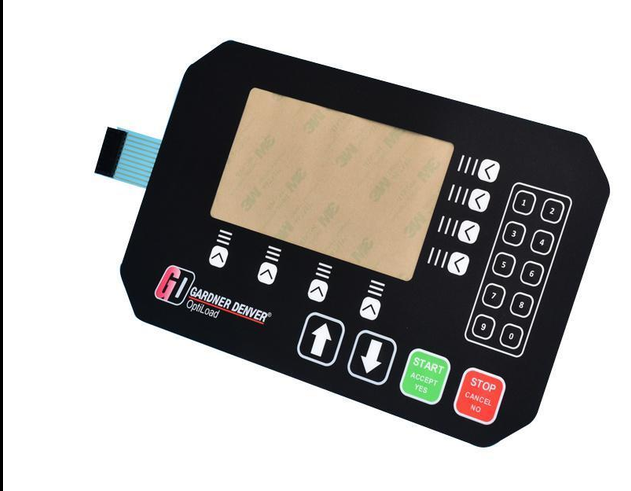
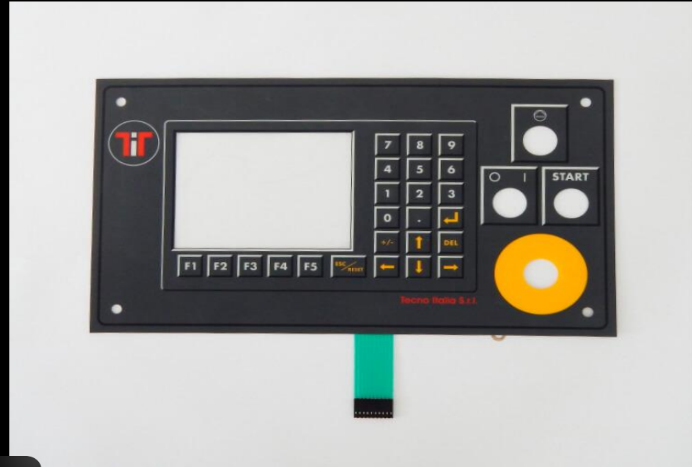
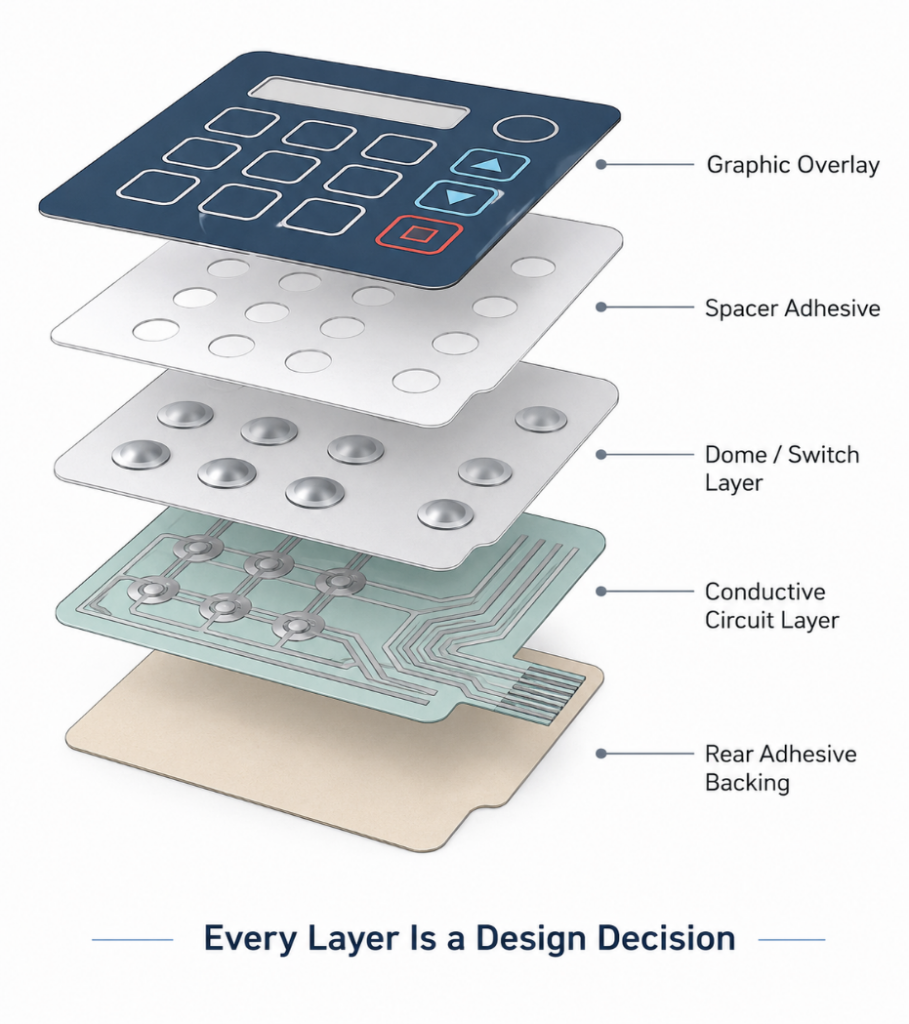
Design and procurement teams often bucket membrane keypads under “labels and stickers” or lump them in with the PCB BOM. Neither is accurate. A membrane keypad/graphic overlay assembly is a multi-layer construction — typically a printed graphic layer, spacer adhesive, circuit layer (silver conductive traces), embossing for tactile/Non Tactile keys, and often a metal dome or polydome layer for switch feel — engineered to a specific electrical and mechanical spec set by the end product, not by a catalogue.
Because it’s a sub-assembly, it carries dependencies most finished-product sourcing doesn’t: connector pinout and pitch, mating with the host PCB, dielectric strength for the overlay material, adhesive compatibility with the enclosure surface, and tolerance stack-up with the bezel or die-cast housing it sits inside. Get any one of these wrongs at the design stage and the fix happens after tooling — an expensive place to discover it.
This is why leading global printed-electronics manufacturers position membrane switches and graphic overlays as engineering-led components rather than commodity parts. The design conversation must start with the requirements of the end system—not with a standard template
Where the HMI Component Market Stands Right Now
A few shifts are worth flagging for anyone specifying or sourcing these components this year:
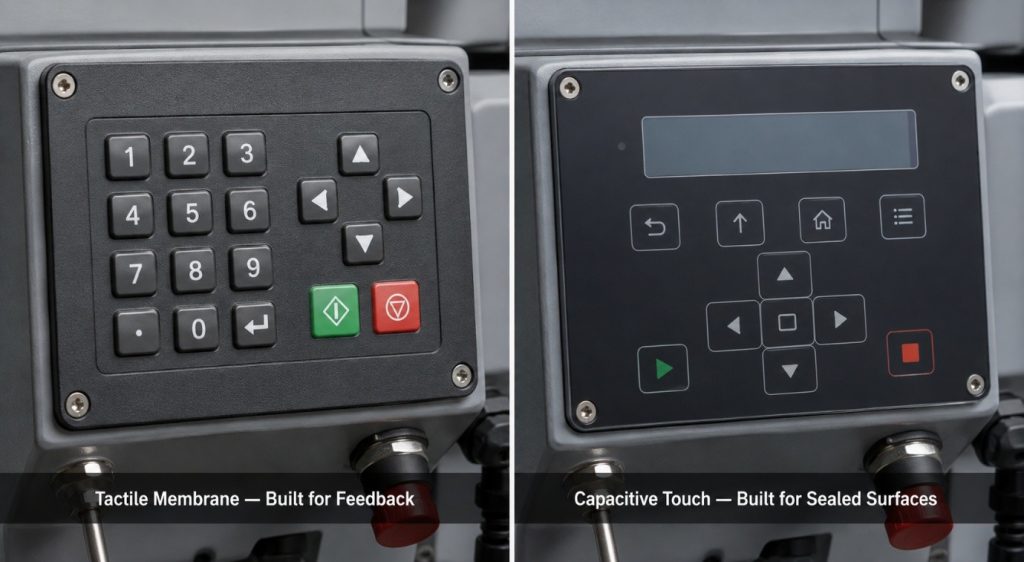
Hybrid interfaces are becoming the default, not the exception. Pure tactile membrane keypads haven’t gone away — glove operation, low-cost matrices, and harsh-environment equipment still Favor a mechanical dome click. But capacitive sensing layered under a graphic overlay is increasingly the first option evaluated for panels that need a continuous, wipe-clean front surface, particularly in medical and food-processing environments where sealed, crevice-free surfaces reduce contamination risk. The two technologies now coexist on the same panel more often than they compete.
Durability specs are getting tighter. OEMs are pushing suppliers on actuation-cycle guarantees (often 1 million+ presses per key), IP-rated sealing against dust and liquid ingress, and chemical resistance to cleaning agents — driven largely by demand from medical equipment, industrial automation, and outdoor/vehicle-mounted panels.
Sustainability is entering the material conversation. Substrate choice, ink systems, and recyclability are showing up in RFQs for the first time, alongside the traditional specs of flammability rating and operating temperature range.
Printed electronics as a category is scaling fast. Industry estimates put the global printed electronics market above USD 15 billion in 2026, with flexible sensors and printed displays as the biggest growth pockets and Asia-Pacific — India included — cited as the fastest-growing manufacturing region. On the policy side, India’s Electronics Components Manufacturing Scheme has seen its outlay raised to ₹40,000 crore in the latest Union Budget, part of a broader push to build domestic component manufacturing capacity rather than rely on imports. For OEMs building products for the Indian market, or exporting from India, that shifts the calculus toward qualifying a domestic sub-assembly partner early rather than treating it as an offshore afterthought.
Branding is now a functional spec, not a cosmetic one. The graphic overlay is the first surface a user touches and the last thing they judge the product on. Embossed keying, matte/anti-glare finishes, backlighting integration, and fade-resistant printing are being written into overlay specs alongside the electrical requirements — because a scratched or faded overlay reads as product failure even when the switch underneath still works perfectly.
What Design and Procurement Teams Should Be Specifying
If you’re writing the spec sheet or evaluating a supplier for this sub-assembly, the questions that separate a reliable partner from a print shop with a laminator are:
- Layer stack transparency — can the supplier walk you through material choice at each layer (PET, polycarbonate, silver ink, adhesive class) and justify it against your environment, not just quote a price?
- Tactile response data — actuation force, travel distance, and cycle life should be measurable, not described in adjectives.
- Electrical integration — connector type, trace routing, and compatibility with your PCB or PCF, confirmed at prototype stage before tooling is cut.
- Environmental sealing — IP rating tested to the standard you need (IP65 for splash, IP67 for immersion), not assumed from a similar past project.
- Prototyping-to-production path — can they take you from a working sample to validated tooling without a redesign, and do they carry the certifications (ISO 9001 and equivalent) your industry’s audit process requires?
This is also why the finished-product framing is misleading. A membrane keypad or graphic overlay that arrives without having been engineered against your enclosure, your PCB, and your use environment isn’t a component you can drop in — it’s a part you’ll be redesigning around later.
What M-Tech Innovations Brings to This Layer
M-Tech Innovations manufactures membrane switches, capacitive touch switches, and graphic overlays as engineered HMI sub-assemblies — built to the customer’s electrical, mechanical, and environmental spec rather than supplied off a shelf. Working from an India-based manufacturing base, with the design and production experience to take a component from prototype through full-scale, certified production, M-Tech sits inside the same category of partner OEMs are now qualifying earlier in the design cycle: one that treats the interface layer as an engineering deliverable, not a print job.
If your product roadmap includes a new control panel, instrument face, or device front in the next planning cycle, the sourcing conversation for this component is worth having before the enclosure design is locked — not after.