
Picture a warehouse manager who can pull up the exact location of every single item on the floor without walking a single aisle. Or a hospital where nobody ever spends twenty minutes hunting for a ventilator. Or a retail shelf that flags itself for restocking before a customer even notices it’s empty.
None of that is a far-off dream anymore. It’s what happens when RFID meets AI, and it’s already running in facilities across the country.
By 2026, RFID has grown well past its old job of “scan the tag, log the item.” It’s become something closer to a nervous system for operations — millions of tag reads flowing in, and AI making sense of them in real time: forecasts, alerts, automated decisions, the works. Retail, logistics, healthcare, manufacturing, automotive — this pairing is quietly becoming the backbone that keeps these industries running smoothly.
At M-Tech Innovations, we work with smart cards, RFID, HMI, and automotive solutions every day, and we’re watching this shift happen up close. So we wanted to break down, in plain terms, what RFID + AI actually means, why it’s worth paying attention to right now, and how Indian businesses can actually use it.
What RFID Actually Is
RFID — Radio Frequency Identification — is a wireless way of tracking objects using radio waves instead of a scanner and a clear line of sight, like you’d need with a barcode. Three pieces make it work:
- RFID Tags — small chips, passive, active, or somewhere in between, attached to whatever you need to track: products, equipment, vehicles, ID cards.
- RFID Readers — fixed or handheld devices that pick up the signal the tags give off.
- RFID Middleware/Software — the layer that takes all that raw tag data and turns it into something a business can actually use.
The advantage over barcodes is simple: you can read RFID tags from a distance, in bulk, and even through packaging. No lining things up, no scanning one at a time. That’s exactly why RFID has quietly become the backbone of inventory management, access control, asset tracking, and supply chain visibility.
Why AI + RFID Is the Real Game-Changer in 2026
Here’s the simplest way to put it: RFID tells you where something is. AI tells you what to do about it. Put them together and you get a genuine feedback loop — not just visibility, but intelligence.
In practice, it looks something like this:
- RFID readers keep capturing data around the clock — where items are, how they’re moving, temperature readings, timestamps.
- AI works through that stream in real time, filtering out the noise, spotting patterns, and cross-checking it against sales figures, shipment records, or maintenance logs.
- Out the other end comes something useful — a demand forecast, a restock alert, a flagged anomaly, an early warning that a machine needs servicing.
And the numbers back up how big this shift really is. The global RFID market is expected to grow by roughly $18.77 billion between 2025 and 2029, at a compound annual growth rate near 14.6%. Much of that growth is coming from wider adoption of inventory tracking systems and a rising use of RFID in data center management — with AI-driven analytics now baked into that story rather than sitting on the side.
Where RFID + AI Is Actually Being Used
1. Retail: Fewer Empty Shelves, Fewer Surprises
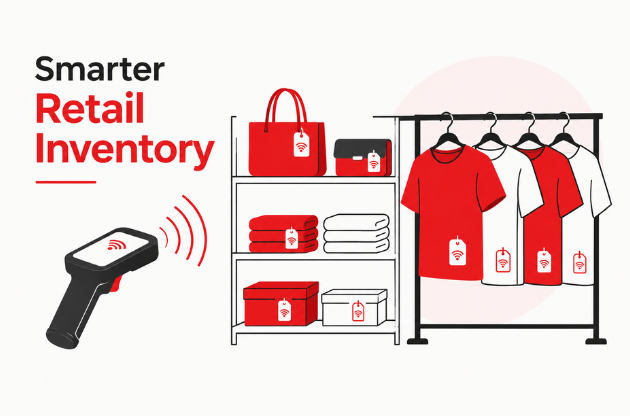
RFID isn’t stuck in the stockroom anymore — it’s out on the sales floor. Smart shelves, self-checkout counters, and those “smart doors” that can tell a paid item from an unpaid one in real time are all built on AI-enabled RFID tracking. Behind the scenes, AI is quietly comparing RFID data against POS records, returns, and shipment logs to catch discrepancies, clean up “ghost inventory,” and predict what’s going to sell next. Retailers using item-level RFID tagging are reporting inventory accuracy above 95% — which is what actually makes real-time omnichannel fulfillment possible, not just a nice slide in a pitch deck.
2. Logistics & Supply Chain: Knowing Where Everything Is, Always
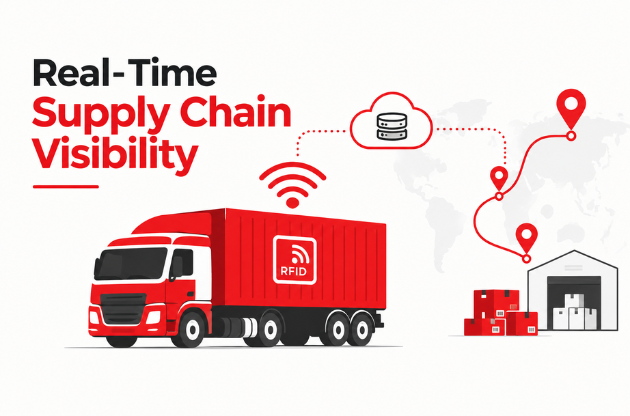
Pair RFID with IoT and AI, and logistics companies get something they’ve wanted for years — real shipment visibility, dock doors that read automatically, and routes that adjust themselves based on live conditions. RFID sensors woven into IoT networks track shipments as they move, keep an eye on temperature and humidity, and flag anything unusual the moment it happens. For India’s fast-moving e-commerce and cold-chain sectors, this isn’t a luxury — it’s becoming table stakes.
3. Healthcare: Fewer Errors, Faster Answers
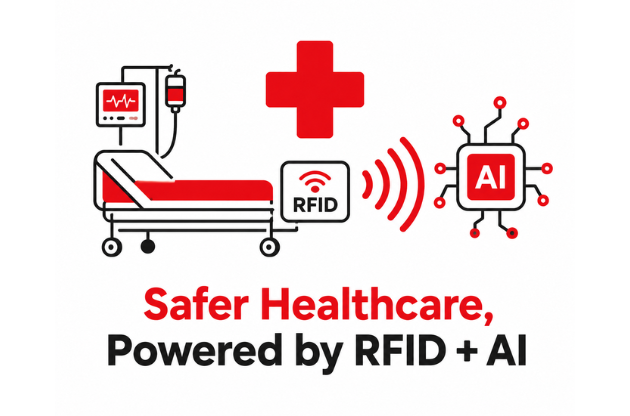
Hospitals may be getting the biggest payoff from all this. AI paired with RFID asset tracking means staff can locate a piece of equipment in seconds instead of searching wards, pharmaceutical inventories can be managed with near-zero error, and medication verification can happen automatically instead of relying on someone double-checking by hand. RFID wristbands, UHF asset tags, and smart cabinets are quickly becoming standard kit in modern healthcare facilities.
4. Manufacturing & Automotive: Catching Problems Before They Become Downtime
On the factory floor, RFID tags embedded in components let manufacturers follow work-in-progress, automate quality checks, and keep compliance records without the usual paperwork headache. AI takes that stream of RFID data and looks for the early signs of equipment trouble — a form of predictive maintenance that’s proving especially valuable for automotive component manufacturers, where downtime is expensive in every sense.
RFID Trends Worth Watching in 2026
- AI built into the readers themselves — no longer a bolt-on layer; AI is increasingly part of the hardware and management platforms from the start, enabling analytics right at the point of the read.
- Chipless and low-cost tags — bringing item-level tagging within reach for small and mid-sized businesses, not just large enterprises.
- RFID + IoT convergence — hybrid sensor networks tracking location, temperature, and condition all at once.
- Sustainability-minded RFID — tag materials and recycling processes catching up with circular economy regulations.
- RFID showing up at checkout — smart doors, RFID-based checkout, and interactive smart carts changing what the retail experience feels like
Why Work With M-Tech Innovations on RFID
As one of India’s established RFID manufacturers and solution providers, M-Tech Innovations puts together an end-to-end range of RFID products built for real industrial conditions, not just lab demos:
- RFID Tags & Labels — UHF, HF, and LF tags for retail, logistics, and industrial settings
- RFID Readers — fixed and handheld, for warehouses, gates, and toll points
- RFID Bolt Seals / E-Seals — keeping cargo integrity intact during transport
- RFID Tracking Solutions — including online prepaid counter systems with RFID-based tracking
- Smart Cards — rounding out RFID deployments with secure identity and access
Whether you’re putting together an AI-ready inventory system, a secure access control setup, or a smart logistics tracking network, M-Tech’s RFID/Reader Division provides the hardware your AI systems actually need to deliver results — not just promises.
Frequently Asked Questions
Q1. What’s the difference between RFID and barcode technology? Barcodes need a direct line of sight and get scanned one at a time. RFID tags can be read in bulk, from a distance, without needing to see them at all — which is what makes RFID so much faster and more scalable for large inventories.
Q2. How does AI actually improve RFID systems? RFID on its own generates a lot of raw data. AI is what turns that flood of reads into something usable — spotting patterns, predicting demand, catching anomalies, and automating the decisions that used to take a person hours to make.
Q3. Which industries benefit most from RFID + AI? Right now, retail, logistics and supply chain, healthcare, manufacturing, and automotive are leading the pack. But the use cases are spreading fast into agriculture, education, and smart city projects too.
Q4. Is RFID expensive to implement in India? Not like it used to be. As tag manufacturing has scaled, prices have come down significantly. Between affordable UHF tags and modular reader systems, even small and mid-sized Indian businesses can adopt RFID tracking without blowing their budget.
Q5. What RFID products does M-Tech Innovations offer? Tags, readers, bolt seals/e-seals, RFID-based tracking and prepaid counter solutions, plus smart card and secure ID products that complement any RFID deployment.
Final Thoughts
RFID and AI have stopped being two separate technologies you bolt together — they’re becoming one integrated system for running smarter, more data-driven operations. The businesses adopting AI-powered RFID now are the ones setting themselves up for faster decisions, lower costs, and better experiences for their customers down the line.
If you’re looking into RFID solutions in India — tags, readers, or a full tracking system — M-Tech Innovations can help you build infrastructure that’s ready for what AI needs next.
Ready to bring smart RFID + AI tracking to your business? Contact M-Tech Innovations today for a consultation.