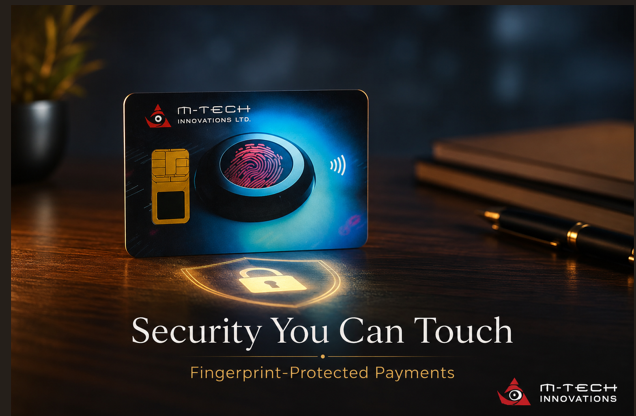
Imagine standing at a checkout counter. Your hands are full of grocery bags. You tap your card, and instead of typing a PIN or signing a slip, you simply touch the card with your finger. A tiny green light blinks. Payment done. No PIN. No pen. No password to forget
That’s not science fiction. That’s a biometric card, and it’s already rolling out across banks worldwide — quietly, one fingerprint at a time.
Let’s break down exactly what this technology is, how it works, and why the biometric card is at the center of this shift, all in plain, everyday language — no engineering degree required.
What Exactly Is a Biometric Card?
Think of your regular debit or credit card. It has a chip, it has your name, and it needs a PIN or signature to prove it’s really you using it.
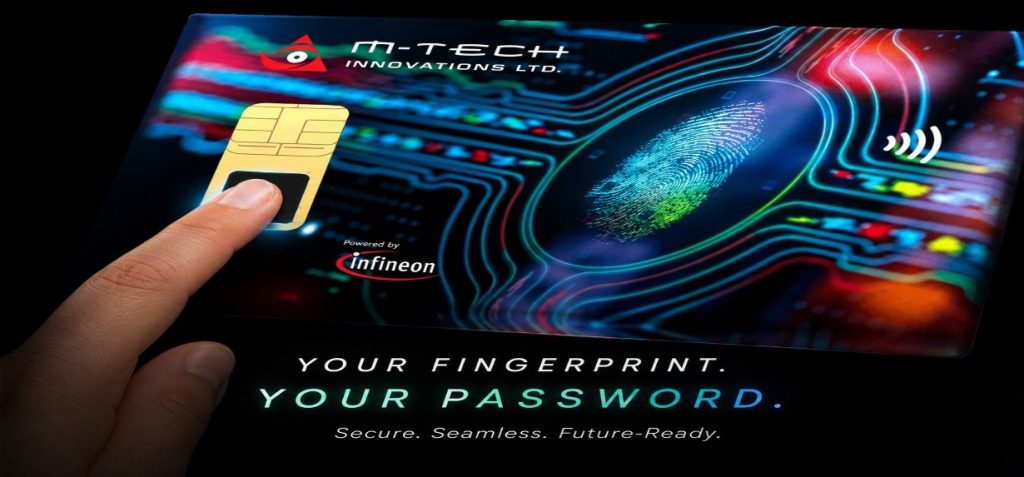
A biometric payment card does one thing differently: instead of a PIN, it checks your fingerprint — right there on the card, in real time, every time you pay.
Here’s the simplest way to picture it:
- Your bank card today = “Enter your PIN to prove it’s you.”
- A biometric card = “Touch your finger to prove it’s you.”
It’s the same idea as unlocking your smartphone with a fingerprint, except now that same trust is built directly into a plastic payment card.
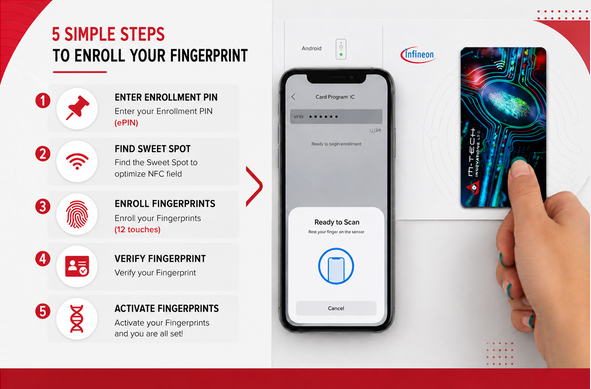
NFC Enrollment Process Flow
The Big Advantages, in Plain Words
What You Get | What It Actually Means for You |
No PIN needed | Just touch and tap — faster checkout, no fumbling |
Works on existing terminals | You can use it at almost any shop that already accepts tap payments |
Fingerprint never leaves the card | Your biometric data isn’t stored on any server or cloud — it stays with you |
Useless if stolen | A thief can’t use your card without your finger on it |
No battery required | The card draws tiny power from the terminal itself during the tap |
Fewer failed transactions | No more “wrong PIN” declines that annoy both shoppers and shopkeepers |
"But Is My Fingerprint Data Safe?"
This is usually the first question people ask, and it’s a fair one.
The honest answer: with this technology, your fingerprint data is designed to never leave the card. It’s not uploaded to a bank database, not sent to the cloud, and not shared with the shop’s payment machine. The verification — the actual “yes, this is you” decision — happens inside the chip on the card, in a fraction of a second, and then the result disappears. Only the payment approval travels onward, exactly like a regular contactless transaction
This “match-on-card” approach is precisely why security experts consider biometric cards a genuine privacy upgrade rather than just a gimmick — you’re adding a lock, not creating a new place your personal data can be stolen from.
Biometric Card vs. Regular Card: Quick Comparison
Feature | Regular Debit/Credit Card | Biometric Card |
Identity check | PIN or signature | Fingerprint |
If stolen | Can potentially be misused | Effectively unusable by anyone else |
Speed at checkout | Type PIN, wait | Touch and tap, done |
Data storage | PIN stored with bank | Fingerprint stored only on card chip |
Extra hardware | None | Small sensor + secure chip module |
Battery needed | No | No |
What Is M-Tech Innovations Bringing to the Table?
Building the chip is one part of the story. Actually turning that chip into a real, bank-ready card that millions of people can safely tap every day is a whole different challenge — and that’s where M-Tech Innovations comes in.
M-Tech Innovations Ltd. is a Pune-based smart card manufacturer with more than three decades of experience, and it’s one of the very few companies in India trusted with Visa, Mastercard, and RuPay certifications for card production. M-Tech reached a genuine milestone: it became the first company in India to receive VISA certification for a locally manufactured biometric payment card, built using Infineon’s security chip together with fingerprint sensor technology from Fingerprint Cards (FPC). In other words, this isn’t a concept on a slide deck — it’s a certified, production-ready card coming out of an Indian factory.
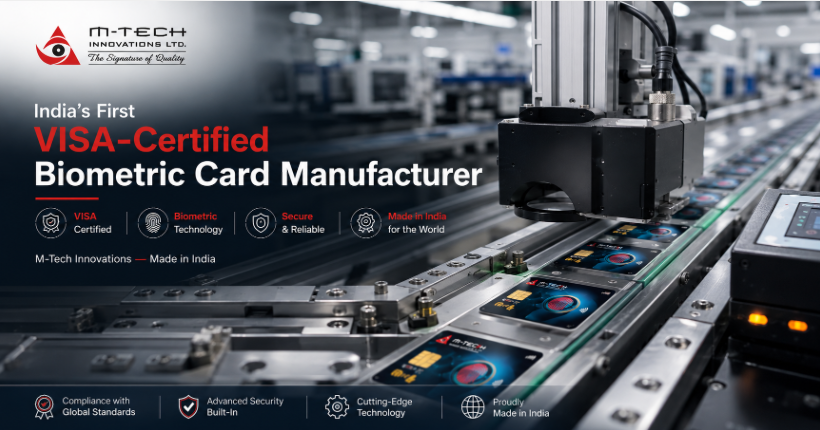
Here’s what that actually means for banks, businesses, and everyday cardholders:
- Make in India, built to global standards. The card is manufactured locally, but held to the same Visa and Mastercard security benchmarks used anywhere in the world — supporting the government’s Make in India push without cutting corners on security.
- Ready for RBI’s new 2FA rules. The Reserve Bank of India is rolling out stricter two-factor authentication requirements for card transactions starting April 2026. A fingerprint-based biometric card is a natural, built-in way to meet that requirement — the second “factor” is simply your finger, with nothing extra for the customer to carry or remember.
- No more PIN-related failures. Forgotten PINs, mistyped PINs, and PIN-related fraud are a daily headache for banks and shoppers alike. Swapping that step for a fingerprint removes the single biggest point of friction in card payments.
- Decades of manufacturing trust. M-Tech isn’t new to secure card production — the company holds ISO 9001, ISO 27001, and IATF 16949 certifications and has been producing smart cards, RFID products, and secure identification cards for banking, telecom, and government clients for over 20 years.
- End-to-end capability. From card body manufacturing to chip personalization to final certification, M-Tech handles the full production pipeline in-house, which means fewer vendors, fewer handoffs, and tighter security across the supply chain.
Why Choose M-Tech for Biometric Cards?
If you’re a bank, fintech, or card issuer evaluating who should manufacture your next generation of payment cards, a few things set M-Tech apart:
- Proven certification, not just promises. Being the first Indian company to earn VISA certification on a biometric card is a strong signal of manufacturing quality and security compliance — this clears one of the hardest hurdles in the industry.
- Local manufacturing, global compliance. Cards are produced within India, which can mean shorter lead times, easier compliance with domestic regulations, and support for Make in India sourcing requirements — while still meeting Visa, Mastercard, and RuPay’s international standards.
- Technology partnerships that matter. By combining Infineon’s secure chip technology with FPC’s fingerprint sensors, M-Tech isn’t experimenting with unproven components — it’s building on hardware already trusted by major global card networks.
- Experience across sectors. M-Tech’s client base spans banking, telecom, and government projects, so the company understands the compliance and security expectations of highly regulated industries, not just retail.
- Timed perfectly with regulation. With RBI’s 2FA mandate approaching in April 2026, banks that move early on biometric cards — through an already-certified manufacturer like M-Tech — can get ahead of the compliance deadline instead of scrambling to catch up.
For any Indian bank or card issuer, the message is simple: the technology is proven, the manufacturing is certified, and the timing — with new RBI rules on the horizon — makes this the right moment to make the switch.