
Every year, millions of pets go missing. Of those, a heartbreakingly small number make it back home — not because people don’t care, but because there was no reliable way to identify them. That’s the problem RFID pet microchip technology was built to solve. And today, with the SafeMyPet app, that technology is more powerful and accessible than ever — for both pet owners and veterinary doctors.
First Things— What Exactly Is RFID?
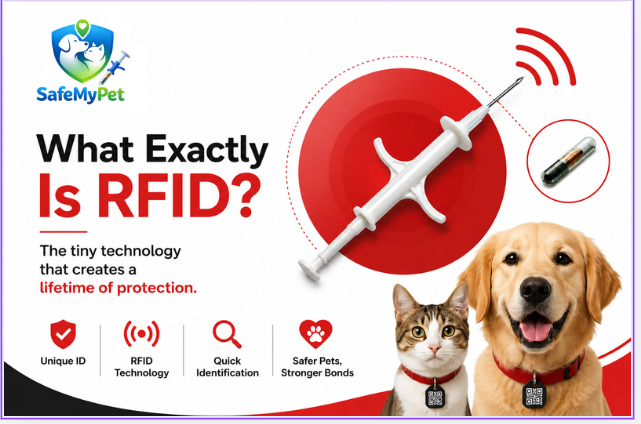
RFID stands for Radio Frequency Identification. In plain language: it’s a tiny chip that stores a unique ID number and can be read wirelessly by a scanner — no battery needed, no internet connection required at the point of scan.
You’ve probably come across RFID without realising it. That tap-to-pay card in your wallet? RFID. The tag on a store item that beeps at the exit? RFID. Library books that auto-check out? Still RFID.
When we talk about an RFID solution for pets, we’re talking about applying this same simple, reliable technology to animal identification — through what’s known as a pet microchip. A tiny RFID tag, about the size of a grain of rice, is implanted under the pet’s skin (usually between the shoulder blades). It holds a unique identification number that can be scanned by any compatible reader.
That number, when linked to a database like SafeMyPet, becomes the key that unlocks everything — your contact details, your pet’s medical history, vaccination records, and emergency instructions. All of it, instantly available to whoever scans your pet.
The Problem With Traditional Pet ID Methods
If you’ve ever used a collar tag or a handwritten tag on your dog’s collar, you already know the problem. Tags fall off. They fade. Dogs swim, run through bushes, or simply chew them off in a moment of boredom.
And even if the tag survives, it can only hold so much information — a name and a phone number at best. There’s no medical history, no emergency contact, no record of allergies, no way for a veterinary doctor to quickly understand the animal’s background.
RFID tags change all of that. They don’t fall off. They don’t fade. A microchip implanted today will still be readable 25 years from now. And with the right platform behind it, that microchip becomes the pet’s permanent digital identity.
| “A collar tag tells you the pet’s name. An RFID pet microchip linked to SafeMyPet tells you everything — and connects the finder directly to the family who’s desperately waiting.”
What Is SafeMyPet and How Does It Work?
SafeMyPet is an app built specifically around RFID pet microchip technology. Think of it as the brain behind the chip — the platform that makes all that stored data actually useful in the real world.
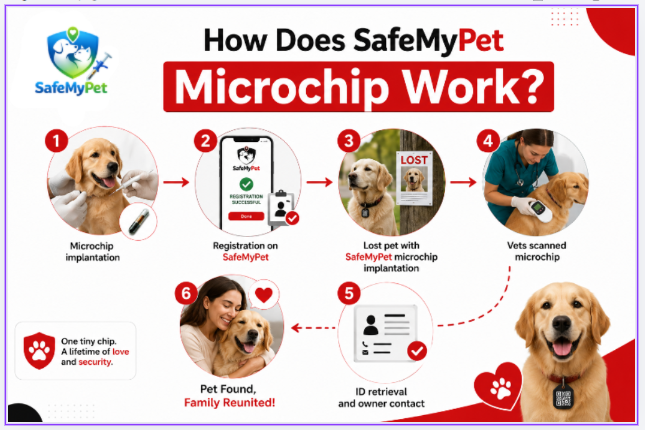
Here’s how the whole system works, from the moment of microchipping to the moment a lost pet comes home:
- Microchip Implantation at the Veterinary Clinic
A veterinary doctor implants a tiny RFID microchip safely beneath the pet’s skin. The procedure takes only a few seconds, causes minimal discomfort, and provides the pet with a unique lifetime identification number.
- Registration on the SafeMyPet App
After implantation, the pet owner registers the microchip ID on the SafeMyPet app. The profile can include the pet’s name, breed, age, photo, vaccination records, medical history, and owner contact details.
- Lost Pet Is Found and RFID Tag Is Scanned
If the pet ever goes missing and is later found by a veterinary doctor, animal shelter, rescuer, or neighbour, the RFID microchip can be scanned using a compatible scanner.
- Instant ID Retrieval and Owner Contact
The scanned microchip instantly retrieves the pet’s SafeMyPet profile. Important information such as the owner’s contact number and pet details become accessible immediately, helping the finder connect with the owner quickly.
- Pet Safely Reunited with the Family
SafeMyPet helps simplify communication between the finder and the pet owner, enabling a faster and safer reunion. Veterinary doctors can also access critical medical information for better emergency care and treatment.
Why This Matters Especially for Veterinary Doctors
A Section Specifically for Vet Professionals
If you’re a veterinary doctor, you already know the frustration of treating an animal without knowing its history. An emergency walk-in with no records is a guessing game at best, and a dangerous one at worst. SafeMyPet is designed to solve this — for you and your entire clinic team.
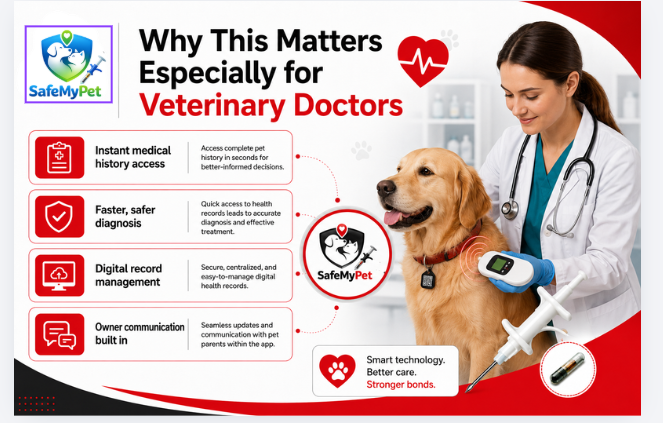
- Instant medical history access A quick scan of the pet’s microchip pulls up vaccines, known allergies, current medications, and prior treatments — right from the SafeMyPet platform.
- Faster, safer diagnosis Knowing a pet’s full background means fewer unnecessary tests, fewer medication errors, and faster treatment decisions — especially in emergencies.
- Digital record management Update the pet’s health records directly from the app after each visit. No paper files to misplace. No illegible handwriting. Everything is timestamped and searchable.
- Owner communication built in Send post-visit summaries, vaccine reminders, and follow-up notes to the owner through the app. It keeps clients engaged and keeps your clinic top of mind.
For veterinary clinics, SafeMyPet isn’t just a pet lost solution — it’s a practice management upgrade. It reduces the time staff spend on administrative tasks and increases the quality of care you can deliver in every appointment.
What SafeMyPet Actually Does for Pet Owners Day to Day
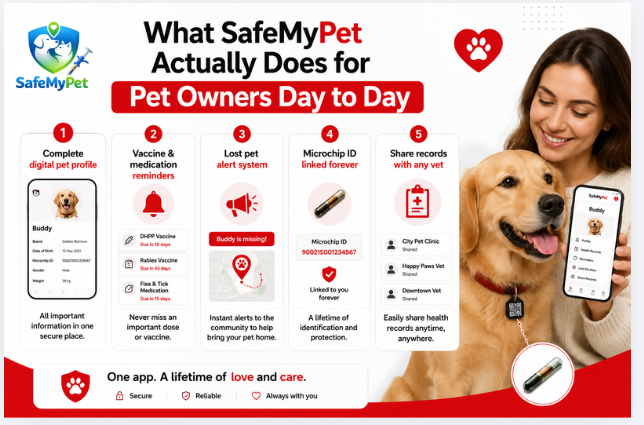
The lost pet scenario gets most of the attention, and understandably so. But the SafeMyPet app is designed to be useful every single day — not just in emergencies. Here’s what pet parents get from it:
- Complete digital pet profile — all health records, vaccines, deworming schedules, and vet visit notes in one place, accessible from your phone anytime.
- Vaccine & medication reminders — never miss a rabies booster or monthly flea treatment again. The app sends timely alerts so you stay on schedule.
- Lost pet alert system — mark your pet as lost within the app and it notifies the SafeMyPet community and nearby registered vets in your area. More eyes looking, faster return.
- Microchip ID linked forever — even if you change your phone, email, or city, your pet’s RFID tag always points back to the most current version of their profile.
- Share records with any vet — travelling with your pet? Moving cities? A new veterinary doctor can scan the chip and get the full picture instantly.
How RFID Technology Compares to Other Pet Tracking Solutions
There are a few different options out there when it comes to keeping tabs on your pet. GPS trackers, QR code tags, and traditional collar ID tags all have their place. But RFID pet microchipping stands out for a very practical reason: it doesn’t require anything from the pet or the owner to keep working.
GPS trackers need a battery. When it dies — and it will, usually at the worst possible moment — the tracker goes dark. QR code tags are great until the tag gets scratched, wet, or simply falls off. Collar tags rely on the collar staying on the pet.
An RFID tag implanted under the skin requires no power source, never expires, cannot be removed accidentally, and doesn’t depend on the pet wearing anything at all. It’s the most reliable form of permanent pet identification that exists today.
That said, the best approach isn’t either/or. Many responsible pet owners use a combination: a microchip for permanent ID, and a GPS tracker for active location monitoring. SafeMyPet supports both — the microchip for identity and records, and the app for alerts and community-based lost pet responses.
Is the RFID Microchip Implant Safe for My Pet?
This is the question every responsible pet owner asks, and it’s a good one. The short answer is: yes, very safe.
RFID pet microchips have been used in animals for over 30 years. They’re passive devices — they contain no battery and emit no signals on their own. The chip only “activates” when a reader passes near it, and even then it only transmits a brief burst of radio frequency energy to send the ID number.
The implantation process is comparable to a standard vaccination — a quick injection, a brief moment of discomfort, and it’s done. Most pets barely react. The chip is encased in biocompatible glass that the body doesn’t reject, and it stays in place permanently without migrating or causing tissue damage.
Major animal welfare organisations, veterinary associations, and regulatory bodies around the world recommend microchipping as a safe, standard practice for all companion animals. Many countries have actually made it a legal requirement for dogs.
Getting Started with SafeMyPet — It’s Simpler Than You Think
If you’re a pet owner, the path is straightforward: visit your veterinary doctor, ask about microchipping, and once your pet has their RFID tag implanted, download SafeMyPet and register the chip ID. The whole setup — implantation, registration, and app configuration — takes less than 30 minutes.
If you’re a veterinary doctor or clinic administrator, SafeMyPet has a dedicated professional dashboard that lets you scan and look up patient records, update health information after visits, and connect with pet owners through the platform. Onboarding your clinic is a one-time process that pays dividends in operational efficiency and client trust every day after.
Frequently Asked Questions
- Can any vet scan my pet’s microchip with SafeMyPet?
Yes. Any veterinary doctor with a standard RFID scanner can read the chip number. If they’re registered on the SafeMyPet platform, they get instant access to the full health profile. Even if they’re not, the chip number can be searched manually on SafeMyPet.
2.What happens if I change my phone number or move to a new city?
Simply update your profile on the SafeMyPet app. The microchip ID stays the same forever — it always points to your pet’s profile, and you can update all contact and location information anytime through the app.
3. Is a pet microchip the same as a GPS tracker?
No. A pet microchip is a passive RFID tag — it doesn’t track location in real time and doesn’t need a battery. It’s an identification tool: when scanned, it reveals who the pet is and how to reach the owner. A GPS tracker actively monitors location in real time but requires power. Both serve different purposes and work well together.
4. Does microchipping hurt my pet?
The implantation is comparable to a standard vaccine injection. Most pets feel a brief pinch and return to normal behaviour immediately. No anaesthesia is required, and the whole procedure takes about 10 seconds.
5. Can I use SafeMyPet for multiple pets?
Absolutely. SafeMyPet lets you manage profiles for multiple pets under a single account — dogs, cats, rabbits, birds, and more. Each pet gets their own RFID-linked profile with individual health records and settings.
Your Pet Deserves More Than a Name Tag
Join thousands of pet owners and veterinary professionals who’ve already made the switch to smarter, RFID-powered pet care with SafeMyPet.
SafeMyPet Android App : https://play.google.com/store/apps/details?id=com.petalert.app&pcampaignid=web_share
SafeMyPet IOS App : https://apps.apple.com/in/app/safemypet/id6757391560
Order SafeMyPet RFID Pet Microchip
Amazon : https://www.amazon.in/dp/B0H1W6BKSD
MTech Mart : https://mtechmart.com/en/pet-microchip-for-dogs-cats-rfid-icar-certified-iso-11784-11785-fdx-b-animal-id-chip
Because every pet deserves a safe way home.